Which Beauty School in Hong Kong? 2026 Objective Guide + International Certification Recommendations
Want to enter Hong Kong's beauty industry? The first question you'll face is: Which beauty school in Hong Kong is right for me? Online information is messy, and choices are many. Some choose the cheapest option only to find no accreditation or hands-on practice; others are misled by “guaranteed employment” or “crash courses,” wasting time and tuition. The truth is, there's no single “best” school — only what suits your personal needs. The key is to understand your goals, recognize industry standards, then compare schools objectively rather than blindly following recommendations.
This guide provides an objective, neutral framework for selecting a beauty school in Hong Kong, highlights common marketing traps to avoid, and introduces LBEDU Academy as one example that meets international accreditation, practical training, and strong post-graduation support. All decisions remain entirely yours — helping you choose wisely and avoid unnecessary pitfalls.

First Understand: Why Does Hong Kong's Beauty Industry Value International Accreditation?
Hong Kong's beauty industry is becoming increasingly regulated. Relying solely on “self-taught skills” or “local unrecognized certificates” makes it difficult to join reputable establishments, erodes client trust, and fails to meet basic practice requirements. For students, especially those learning hands-on procedures, it's vital to study in a threat-free environment — safe, comfortable, and standardized — allowing you to concentrate on skill acquisition while ensuring personal safety and practical experience.
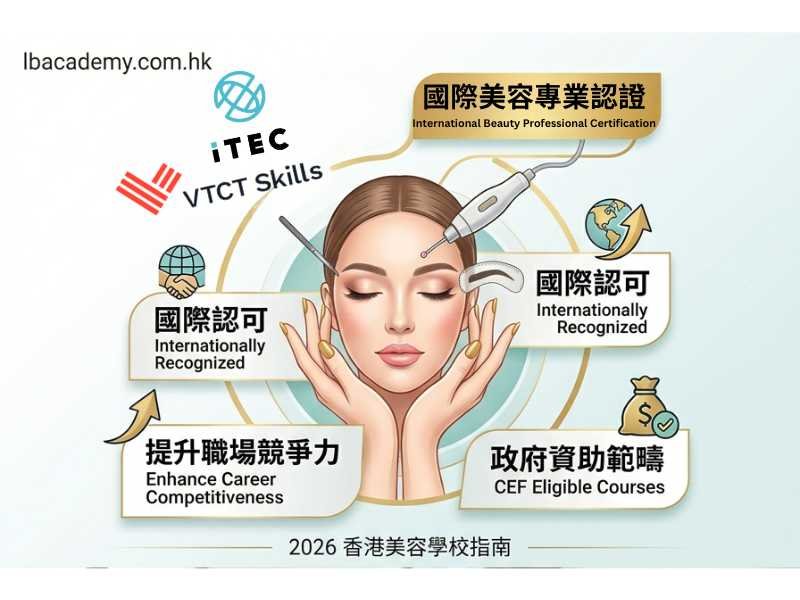
The most respected global certifications include ITEC (International Therapy Examination Council) and VTCT — European authorities — as well as qualifications under the Hong Kong Qualifications Framework (HKQF), which itself has international recognition through mutual agreements with many countries. ITEC, founded in 1947, is regulated by the UK government and OFQUAL, recognized in over 40 developed nations including the UK, US, Canada, Australia, Europe, and Hong Kong. Many high-end spas and medical aesthetic centres require ITEC certification. HKQF accreditation not only facilitates overseas practice and global networking but also provides access to international beauty competitions. For technical beauty courses, international accreditation proves both skill competence and compliance with health and safety standards — reducing career risks, increasing pricing power, and opening doors to higher income and career growth.
Objective School Selection Criteria: Which Beauty School in Hong Kong? Check These 5 Points
Whichever school you consider, compare these five core indicators rationally to avoid emotional decisions or falling for cheap traps:
- Legitimate and authoritative accreditation: Prioritize schools with ITEC, VTCT, or government-recognized training qualifications. Avoid “self-awarded” or invalid certificates — ensure your diploma is valid for practice and promotion.
- Theory + hands-on integration: Beauty is a technical field. Theory alone is useless. Ensure sufficient practical hours, professional equipment, and real-client scenario training so you're job-ready upon graduation.
- Transparent, no hidden fees: Confirm total fees upfront, including any extra exam, material, or tool costs. Reject “low entry fee + endless add-on charges” models.
- Qualified instructors: Ideally, instructors have industry experience and international examiner credentials — not just theoretical knowledge without frontline practice.
- Post-graduation support: Includes free revision, technique updates, job referral, or entrepreneurship guidance. For beginners, such support greatly reduces early-career difficulties.
Common Pitfalls: Watch Out for These Beauty School Marketing Claims
- “Crash course, guaranteed high-paying job” — Beauty skills take time to master; crash courses rarely deliver competence. “Guaranteed job” is often just a slogan — your skills speak for themselves.
- “Cheaper is better” — Extremely low fees usually mean reduced practical training, poor materials, or hidden costs. You may end up spending more to re-learn elsewhere.
- “Only high-end procedures, ignoring safety and hygiene” — For procedures involving skin penetration, hygiene and risk control are critical. Be wary of schools that hype results but skip safety education.
- “No assessment standards, guaranteed pass certificate” — Genuine international certifications have uniform exams. A “guaranteed pass” means the certificate has no value and won't be recognized in the industry.
Objective Reference: LBEDU Academy (Luster Beauty International Education and Training Academy) – Courses & Advantages (Meets Above Criteria)
Many students researching schools ask about LBEDU. Here is an objective explanation of its qualifications and programmes for your comparison — not the only option, but a reference to help you judge based on your needs.
Basic Qualifications & Recognition
LBEDU is a Hong Kong government-recognised employment referral agency. Courses are officially authorised by ITEC and VTCT, and the academy partners with international brands like Biotouch and PMU Factory. Certificates comply with the UK RQF and EU qualifications frameworks, recognised in over 40 countries, meeting Hong Kong's practice standards.
Transparent Fees & Benefits
- Fully transparent pricing — no hidden fees. Exam costs included; you may deduct HK$2,000 if you opt out of official ITEC assessment.
- Graduates can return for free revision to keep up with technique updates.
- As a government-recognised employment referral agency, outstanding graduates receive job referrals and teaching assistant opportunities.
- Additional benefits: online technical support, wholesale discounts on international beauty brands, graduation ceremony, overseas beauty competitions, and rental of on-campus beauty rooms to assist entrepreneurship.

How to Choose Courses & Schools Based on Your Needs (with Continuing Education Fund Reference)
For students seeking further education, career change, or self-improvement, prioritise institutions offering Continuing Education Fund (CEF) courses. The main advantage of CEF courses is that they ease financial pressure — whether you are an employee wanting to upskill, a beginner switching to beauty, or simply adding new skills, CEF reduces the burden of tuition fees. Genuine CEF courses are monitored by the Hong Kong Council for Accreditation of Academic and Vocational Qualifications (HKCAAVQ) to ensure teaching quality and industry relevance, preventing waste of time and money. Moreover, HKQF itself is an international qualification with mutual recognition overseas. Many students who complete HKQF-accredited CEF courses later progress to UK and European qualifications (e.g., ITEC, VTCT series), upgrading their credentials — expanding overseas opportunities, facilitating exchanges with international peers, and even gaining entry tickets to global beauty competitions. This benefits both local and overseas practice.
Additionally, if an institution holds “government-recognised employment referral agency” status, it's a major plus — you not only gain skills and certification but also receive job change, company transfer, or even industry-switching assistance, lowering employment and career transition hurdles.
Everyone's situation is different; course direction should vary accordingly. Here are objective suggestions:
- Beginners, limited budget, quick entry: Choose properly accredited foundational beauty courses with transparent fees and ample practical hours. CEF-supported courses are a priority to reduce financial stress.
- Existing practitioners wanting higher pricing power & avoiding price wars: Consider scarce advanced courses (e.g., skin reconstruction, scar repair) with smaller competition and higher margins. Ensure international accreditation and hands-on training; also check for CEF support.
- Planning overseas development / expanding global vision: Prioritise HKQF-accredited courses (already internationally recognised) or global certifications like ITEC/VTCT. These facilitate overseas practice, cross-border networking, and even entry to international competitions — avoiding limitations of locally-only credentials.
- Working professionals, time-constrained / budget-sensitive: Choose part-time, short-duration courses that don't disrupt your job. Focus on transparent fees, CEF eligibility, and career referral services to smooth your professional transition.
Conclusion: Which Beauty School in Hong Kong? The One That Fits YOU Best
There is no perfect beauty school — only the one that best matches your needs. Before deciding, clarify your goals (entry/upgrade/entrepreneurship), budget, and time availability. Compare accreditations, curriculum, fee transparency, instructor quality, and post-graduation support. If possible, visit the campus, see the practical environment, or attend a trial class.
LBEDU, as an option that meets international accreditation, transparent pricing, and comprehensive support, suits students who value authoritative credentials, hands-on teaching, and long-term development. Still, we encourage you to compare multiple institutions. Ultimately, enrolment is entirely your own decision based on your unique needs. Long-term success in the beauty industry requires both strong technique and solid qualifications. Choosing the right course and school is only the first step — continuous learning, practical experience, active participation in overseas exchanges and international competitions, and broadening your global perspective will help you thrive in the industry and achieve overseas development goals. For those interested in overseas exchanges or international competitions, look for institutions that provide concrete support (e.g., competition entry assistance, international networking channels) to boost your career.

Comments (0) :
No comments yet.
Leave a Comment:
Login to comment